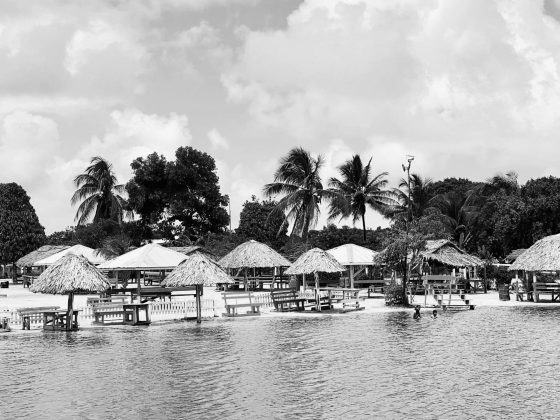
Backyard Café Guyana isn’t a restaurant. It’s Chef Delven Adams’ childhood yard—and the clearest answer to what Guyanese food deserves on the world stage.
TIME Magazine named it one of the world’s greatest places to eat. It has no sign. No menu. No address any concierge will offer. It sits in a backyard in West Ruimveldt, and it is the hardest table in Georgetown to book.
There is a specific kind of discovery that Georgetown’s new hospitality boom cannot manufacture: the moment you find yourself sitting in someone’s childhood backyard, eating the best meal of your trip. At the same time, a chef explains the history of cassareep at your elbow, and a tortoise moves slowly beneath your chair. That is the Backyard Café. That has always been the Backyard Café. What has changed in 2026 is that the rest of the world now knows it.
Chef Delven Adams started cooking in this yard in West Ruimveldt for the same reason most great things begin: a love of the act itself, and a community that responded. He had no formal culinary training. He had ingredients, instinct, and a childhood home in a working-class neighbourhood that no travel guide had ever mentioned. In 2026, TIME Magazine listed Backyard Café among its 100 World’s Greatest Places.
Susan Rodrigues, Minister of Tourism, Industry and Commerce, personally presented Adams with a ministry plaque. Gordon Ramsay cooked pepperpot alongside Adams for an episode of National Geographic’s Uncharted, introducing the dish to a global audience, though the segment was filmed in Guyana’s interior, not at the Backyard Café itself. None of this has moved the restaurant. It is still in the backyard.
Table of Contents Show
“I didn’t get any sleep. When you see a headline like that, you understand the prestige behind it. It’s basically an award. People will now want to come and see for themselves if it really is that good, so we have to stay on top of our game.”
One Party. No Menu. No Sign. No Walk-Ins.
The most important thing to understand about Backyard Café before you try to visit it is that it does not operate like a restaurant. There is no printed menu. The gate carries no sign. A table requires a reservation, and a reservation is not guaranteed even when you ask for one.
Critically, Adams caters for only one party at a time. This is not a dining room. It is a private experience in a private home, which means capacity on any given day is the size of your group, and nothing else. It is also why a single bad cancellation can wipe out an entire evening’s sitting for every person in it.
The process begins with a WhatsApp message, sent months in advance. When you book, the team asks for your protein preference: fish, chicken, or lamb. That preference is the starting point. What Adams actually serves depends on what the morning brings. He sources from Bourda Market and Stabroek Market, often taking guests along on the market trip itself, a culinary experience that begins before the meal does. From there, he builds what he describes as a “culinary story crafted on the fly.”
“We don’t ask who you are or where you’re from. When we meet at the market or around the table, we just talk about food and life and we become friends… It’s within that setting, we met… nothing is forced.”
The result is that no two meals at Backyard Café are the same, which is also why it cannot be reviewed in the conventional sense, and why TGE will not pretend to do so.

An Honest Warning
We want to be direct with you, because a trusted guide owes you the full picture, not just the beautiful parts.
Backyard Café is, as of 2026, genuinely difficult to access, and the access problem is not simply about demand outpacing supply. The booking process itself is unreliable in ways that go beyond unavailability. One traveller spent more than six weeks attempting to book for a single person through email, WhatsApp, and phone calls, receiving no response at all. Contact came only after she went public on social media; she was then told reservations were full and that “people usually book months in advance,” a response that was cold comfort given she had been trying to do exactly that since February.
That experience is not isolated. A separate party, a group of sixteen, on their fourth visit, who had previously brought two large groups, confirmed a reservation months ahead, reconfirmed with the manager two days before, arrived on the night, and found their booking had been silently cancelled. No call. No email. No apology from the owner. These are not edge cases. They are a documented pattern, and your itinerary should account for the possibility that a confirmed reservation may not hold.
We include this not to discourage you. If you get a table at Backyard Café, it will very likely be the best meal of your trip. We include it because sending you there without this information would be irresponsible.
Booking the Table
Read this before the trip is planned, not after the flights are booked.
Start three to four months out. Not weeks. Not one month. The TIME listing has permanently extended the booking curve. For the Jubilee period specifically, your window has likely already closed.
Use every channel at once. WhatsApp is primary. Also, contact the Guyana Tourism Authority and Wilderness Explorers, who partner on culinary tours and sometimes hold reserved slots independently.
Get confirmation in writing. A verbal booking is not a booking. A WhatsApp reply confirming the date, time, and party size is the minimum. Reconfirm 48 hours before. Even then, have a backup plan.
Do not make it the anchor of your trip. Build an itinerary where Backyard Café is the best possible addition, not the centrepiece you cannot lose. If it comes through, wonderful. If it doesn’t, and it may not, your trip should still hold.
Never arrive unannounced. The gate will not open. There is no wait list, no walk-in policy, and no manager available at the door. Arrive only with a confirmed reservation.
Expect cost to scale with the experience. A simple private lunch is one price, a four-course dinner with the morning market tour is another. Ask Adams’ team for an estimated total when you confirm—and budget toward the upper end if you want the full chef-led experience.
What the Kitchen Speaks
Because the menu changes with every market trip, what follows is not a dish list. It is a field guide to the ingredients and preparations that define Adams’ cooking, the signatures that recur across seasons even as specific plates shift. Do not arrive expecting to order. Arrive expecting to be fed.
The meal tends to begin before you sit down. Guests who join the morning market tour, which Adams offers as a companion experience to the lunch or dinner sitting, arrive already oriented to what they are about to eat. They have touched the produce, tasted fruit at the stalls, watched Adams move through Bourda or Stabroek as someone every vendor knows by name.
At the table, the opening is often a cold drink, a basil-infused water, or a glass of Swank, Guyana’s limeade, fresh-squeezed lime sweetened with Adams’ touch of wild local honey in place of the usual Demerara sugar. Then something small and cold to settle you into the pace: a starter soup, a dip, a demonstration. The meal that follows is built around what was freshest that morning.
Signatures Across Seasons
Taro leaf (known locally as eddo leaf or dasheen bush) dip alongside fried breadfruit appears frequently as an opener and is one of the dishes diners mention most when describing a Backyard meal. Adams’ fish preparations are the clearest expression of his fresh-catch philosophy: whole roasted snapper arrives with the bones still in, because that is how it is best. Bangamary ceviche uses Guyanese fish with the heat of local peppers. Cassareep, the Indigenous Amerindian sauce made from reduced cassava juice, is the flavour foundation Adams returns to most often.
For the Uncharted episode, he chose pepperpot. The cassareep chose itself. Coconut bread comes warm, and is not incidental. Metemgee (Metem), the rich coconut-based ground provision stew, appears when the market calls for it. Farine, the cassava-based grain that visitors unfamiliar with Guyanese cooking sometimes approach cautiously, arrives transformed by Adams’ preparation.
Beyond the Plate
A note on cost: there are no fixed prices. It is reasonable to ask Adams’ team for an estimated total when you confirm your reservation. Standard private menus have historically run around 6,000 Guyanese dollars per person (~$28 USD); current multi-course dinners and market-tour-and-meal experiences land closer to $50 USD per head. This is not cheap by Georgetown standards, and it is, by almost any other standard, worth it.
Adams spends time at each table, not as a performance of hospitality, but because this is how he has always eaten and cooked, in conversation with the people sharing the food. He will explain the nutmeg and cloves that link Guyanese cuisine to Indian and African heritage. He will tell you where the fish came from that morning. He will connect the ingredients on your plate to the rivers and soils of a country he came back to in 2014 and has not left since. The food is the beginning of the conversation, not the end of it.

Why This Backyard Matters
The Backyard Café matters to The Guyana Edit for reasons that go beyond the food, as extraordinary as the food is. It is the clearest single answer to the question this publication exists to ask: what does it mean to belong to a place?
Adams left. He came back, set up a kitchen in his childhood yard, and started cooking the food of his country for anyone who would sit down with him. The global recognition, TIME, National Geographic, the diplomats and executives who now fill the reservation list, arrived because he was already doing this. It did not change the backyard. It did not move the restaurant to a hotel lobby, install a prix fixe menu, or require a dress code. It just meant more people had to ask sooner.
While the Marriott and the Four Points by Sheraton tell you Georgetown has arrived by global standards, the Backyard Café tells you it was always worth arriving for. That distinction is the whole story of Guyana in 2026, contained in one yard in West Ruimveldt.
“Our food is amazing. This shows the world that we have something special here.”